
Timeplan uses recorded sickness absence and the settings of the deviation code to construct a sickness period. The waiting period is calculated as 20 percent of the employment's weekly working hours and can be distributed over several sick days. Once the waiting period is filled, the remaining sickness absence is allocated to the regular sickness account and after the deviation code’s sickness period to the account for the social insurance agency.
This article describes Timeplan's calculation method and is not a legal assessment of entitlement to sick pay. Please verify the final payroll basis with your payroll manager and payroll system.
A sickness code must have the type Sickness to be included in Timeplan's sickness calculation. Full-day absence uses the day’s planned working hours as the basis. Partial-day absence is recorded as an amount of time or a fixed percentage and does not automatically shorten the working shift.
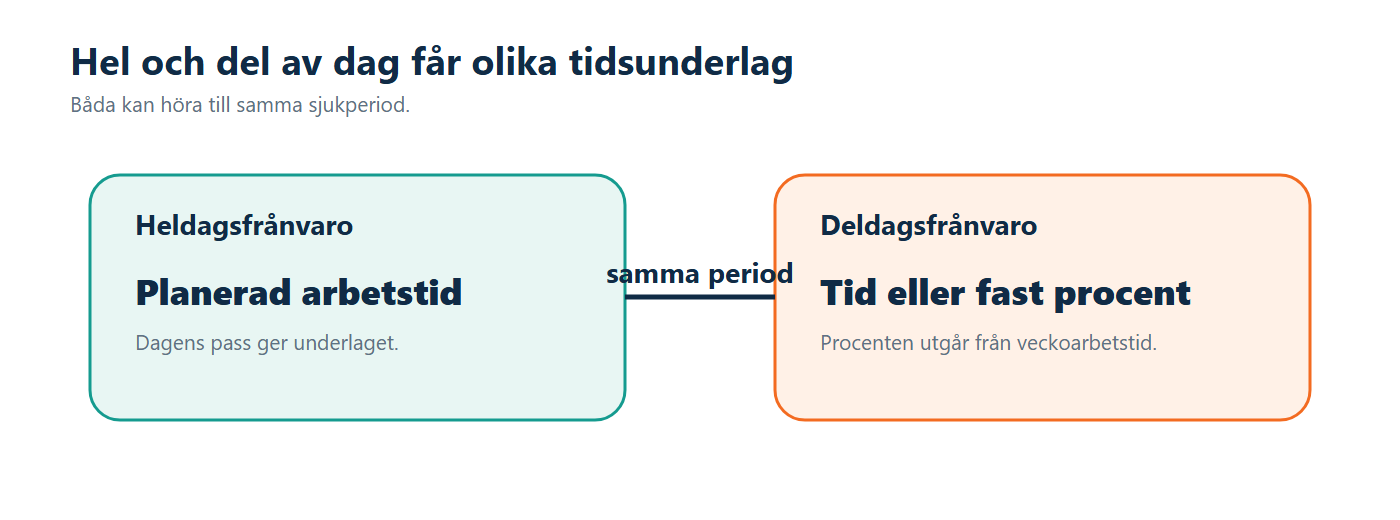
When partial-day absence uses a fixed percentage, the time is calculated from the employment's weekly working hours, normally distributed over five days. The percentage is therefore not automatically deducted from the length of that specific day's working shift.
The deviation code’s Reoccurrence setting determines how far back Timeplan searches for previous sickness absence. The search uses calendar dates. Days off between two recorded sick days do not automatically break the connection.
When a previous sick day is found, the system setting Country affects how the sick day numbering continues. For Norway, numbering continues from the previous recorded sick day without adding the intervening calendar days. For other countries, the calendar days in between are counted. However, the search interval for reoccurrence is measured in calendar dates for all countries.
When both full-day and partial-day codes relate to sickness, the full-day code is used to determine the sickness period. The date is not counted twice as two sick days, but the two absence times are treated separately. Therefore, check that the same time has not been recorded twice.
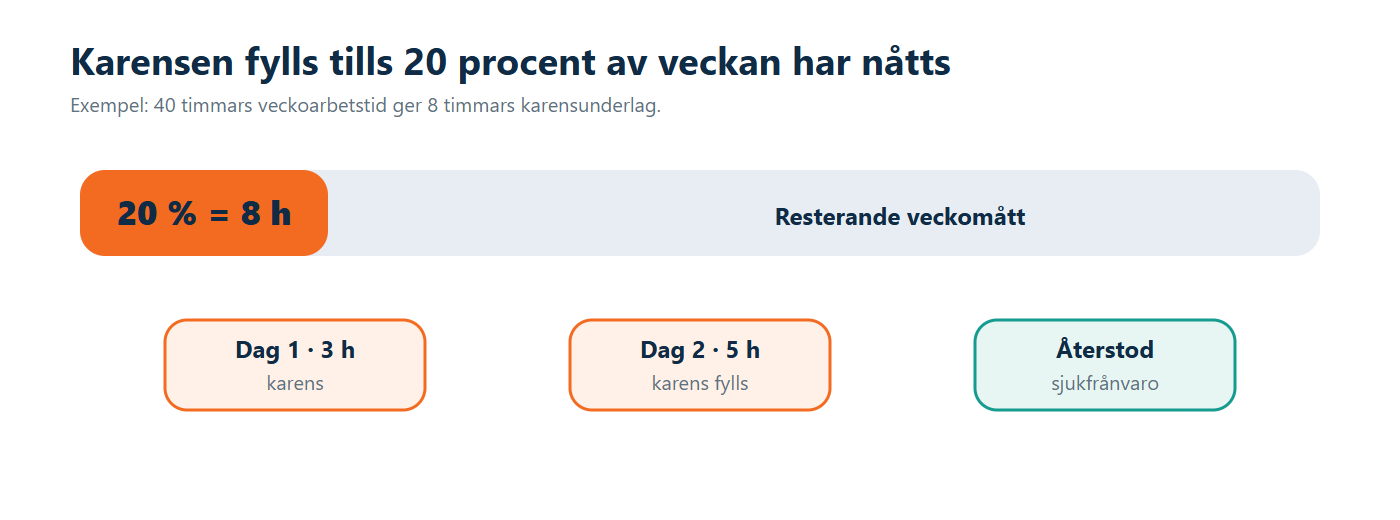
The waiting period limit is 20 percent of the employment's weekly working hours. Time already allocated to the Waiting period account within the same sickness period is deducted before processing the next sick part.
If there is no time on the Waiting period account, a correct waiting period result will not be created. An unexpected error message about a unit also needs to be investigated against the selected account; do not change the absence code to work around the error.
Once the waiting period is filled, remaining sickness absence goes to the deviation code’s regular Account as long as the date is within the code’s Sickness period. After that limit, the absence is allocated to the Social insurance agency account.
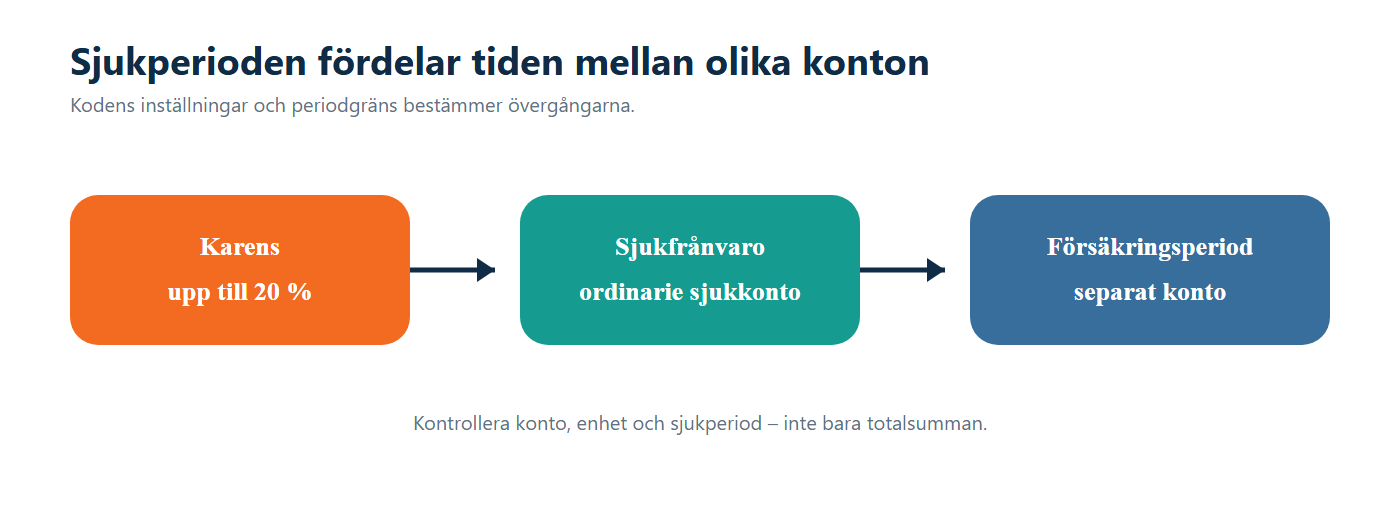
If the social insurance account is missing, the regular sickness balance after the limit is not retained. Therefore, check both the length of the sickness period and all three account selections when later days lack the expected result.
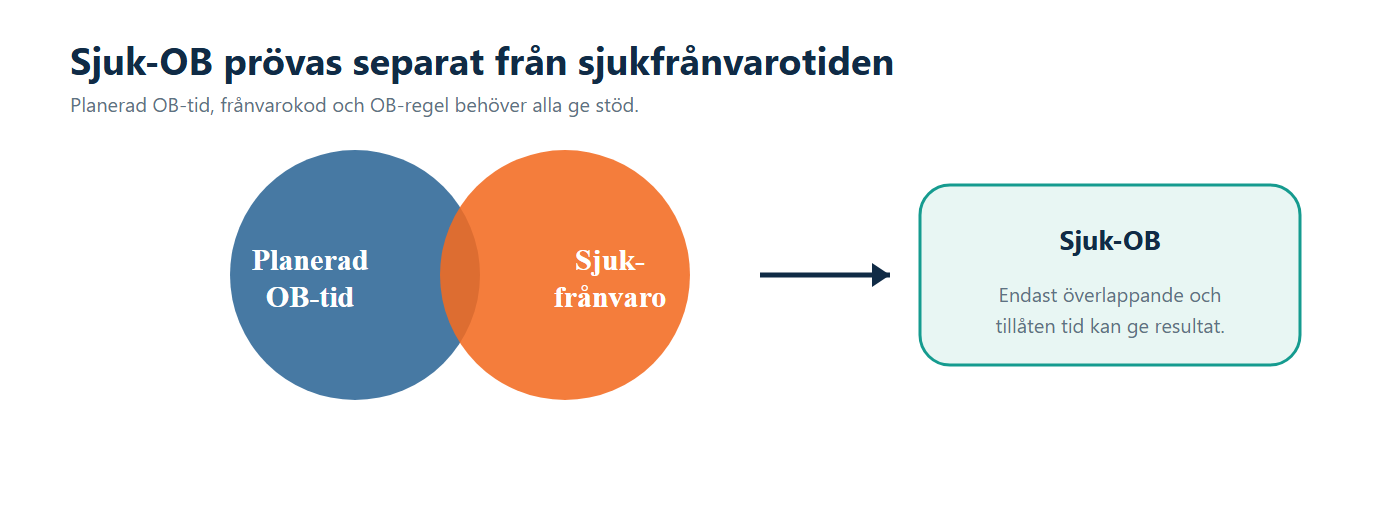
Sickness absence does not automatically generate shift allowance (OB). The time must overlap an OB rule and the rule must have a Sickness account/account rule that produces a result.
- During sickness period retains sickness-related OB during the employer period, but not for the waiting period portion or the time after the sickness period’s limit.
- All days includes sickness OB also for these parts when the OB rule’s other conditions are fulfilled.
- Type of absence code determines whether the registration is treated as sickness.
- Full day or part of day determines how the time base is derived.
- Weekly working hours determine the extent of the waiting period and the basis for a percentage-based part-time.
- Reoccurrence determines whether a previous sick day belongs to the same period.
- Waiting period account, Account, and Social insurance account determine where the different parts are stored.
- Sickness period dictates when the later account path starts being used.
- OB rule’s sickness selection determines whether sickness absence additionally generates sickness-related OB.
Example: The employee has 40 hours weekly working time, which gives an eight-hour waiting period in Timeplan’s calculation. Three hours of sickness absence on the first day are allocated to the waiting period account. On the next sick day, five hours are first used to complete the waiting period. Remaining sickness absence that day goes to the regular sickness account when other conditions are met.
Example: A continuous sickness period spans a day off. The calendar day can be included when the sick day number is determined, but without planned or recorded sickness absence time, the day may not receive a sickness balance.
- Deviation codes contain sickness type, reoccurrence, sickness period, and account selection.
- Clockings and balances show the day’s registration, balances, and calculation messages.
- Managing sickness, waiting periods, and care for children describes how absence is recorded and followed up.
- OB rules govern sickness-related OB during eligible clock intervals.
- Deviation reports use separate report selections and should not be compared with the day’s balances without first reconciling the bases.
The waiting period has a fixed extent of 20 percent of weekly working hours. If the first day’s sickness absence is longer than the remaining waiting period, the rest goes to the regular sickness account.
The first day did not contain enough sickness absence hours to fill the threshold. Timeplan deducts the already registered waiting time and continues within the same sickness period.
Check that the sickness absence overlaps the OB interval, that sickness-related OB is allowed for the correct part of the sickness period, and that the OB rule's sickness account or account rule yields a result.